
선택과목: 미적분
미적분 5지선다형
23. $\displaystyle\lim\limits_{x\to0}\dfrac{\ln(x+1)}{\sqrt{x+4}-2}$의 값은? [2점]
① $1$ ② $2$ ③ $3$ ④ $4$ ⑤ $5$
풀이
분모를 유리화하면 $\dfrac{\ln(1+x)}{\sqrt{x+4}-2}=\dfrac{\ln(1+x)(\sqrt{x+4}+2)}x$이다.
$\begin{aligned}\displaystyle\lim\limits_{x\to0}\dfrac{\ln(1+x)}{\sqrt{x+4}-2}&=\displaystyle\lim\limits_{x\to0}\dfrac{\ln(1+x)}x(\sqrt{x+4}+2)\\&=1\times(2+2)=4\end{aligned}$
정답: ④ $4$
24. $\displaystyle\lim\limits_{n\to\infty}\dfrac1n\sum\limits_{k=1}^n\sqrt{1+\dfrac{3k}{n}}$의 값은? [3점]
① $\dfrac43$ ② $\dfrac{13}9$ ③ $\dfrac{14}9$ ④ $\dfrac53$ ⑤ $\dfrac{16}9$
풀이
정적분의 정의 $\displaystyle\lim\limits_{n\to\infty}\dfrac1n\sum\limits_{k=1}^nf\left(\dfrac kn\right)=\displaystyle\int\nolimits_0^1 f(x)\,dx$를 적용한다.
$\begin{aligned}\displaystyle\lim\limits_{n\to\infty}\dfrac1n\sum\limits_{k=1}^n\sqrt{1+\dfrac{3k}{n}}&=\displaystyle\int\nolimits_0^1\sqrt{1+3x}\,dx\\&=\left[\dfrac29(1+3x)^{\frac32}\right]_0^1\\&=\dfrac29(8-1)=\dfrac{14}9\end{aligned}$
정답: ③ $\dfrac{14}9$
25. 등비수열 $\{a_n\}$에 대하여 $\displaystyle\lim\limits_{n\to\infty}\dfrac{a_n+1}{3^n+2^{2n-1}}=3$일 때, $a_2$의 값은? [3점]
① $16$ ② $18$ ③ $20$ ④ $22$ ⑤ $24$
풀이
등비수열의 첫째항을 $a$, 공비를 $r$이라 하면 $a_n=ar^{n-1}$이다. 분모는 $3^n+2^{2n-1}=3^n+\dfrac{4^n}2$이다.
분자와 분모를 $4^n$으로 나누면 $\dfrac{a_n+1}{3^n+2^{2n-1}}=\dfrac{\dfrac a4\left(\dfrac r4\right)^{n-1}+\dfrac1{4^n}}{\left(\dfrac34\right)^n+\dfrac12}$이다.
주어진 극한값이 양수 $3$으로 존재하므로 $r=4$이어야 한다. $|r|<4$이면 극한이 $0$이고, $|r|>4$이면 유한한 극한이 존재하지 않는다. $r=-4$이면 부호가 교대하여 극한이 존재하지 않는다.
$r=4$일 때 극한은 $\dfrac{a/4}{1/2}=\dfrac a2=3$이므로 $a=6$이다. 따라서 $a_2=ar=6\times4=24$이다.
정답: ⑤ $24$
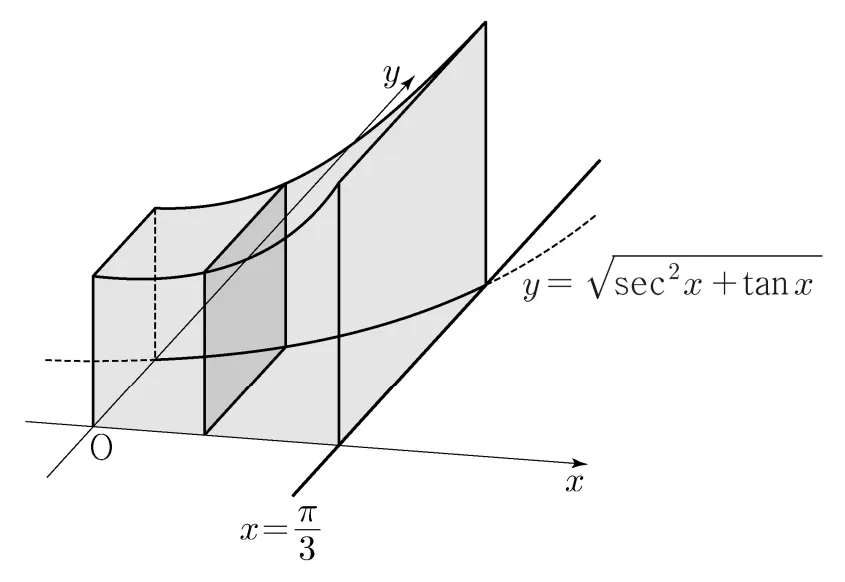
26. 그림과 같이 곡선 $y=\sqrt{\sec^2x+\tan x}$ $\left(0\le x\le\dfrac\pi3\right)$와 $x$축, $y$축 및 직선 $x=\dfrac\pi3$으로 둘러싸인 부분을 밑면으로 하는 입체도형이 있다. 이 입체도형을 $x$축에 수직인 평면으로 자른 단면이 모두 정사각형일 때, 이 입체도형의 부피는? [3점]
① $\dfrac{\sqrt3}{2}+\dfrac{\ln2}{2}$ ② $\dfrac{\sqrt3}{2}+\ln2$ ③ $\sqrt3+\dfrac{\ln2}{2}$ ④ $\sqrt3+\ln2$ ⑤ $\sqrt3+2\ln2$
풀이
$0\le t\le\dfrac\pi3$에서 $x=t$에 수직인 단면은 한 변의 길이가 $\sqrt{\sec^2t+\tan t}$인 정사각형이다.
따라서 단면의 넓이는 $S(t)=\sec^2t+\tan t$이며 부피는 $V=\displaystyle\int\nolimits_0^{\frac\pi3}(\sec^2x+\tan x)\,dx$이다.
$\begin{aligned}V&=\left[\tan x-\ln|\cos x|\right]_0^{\frac\pi3}\\&=\tan\dfrac\pi3-\ln\left(\cos\dfrac\pi3\right)\\&=\sqrt3-\ln\dfrac12=\sqrt3+\ln2\end{aligned}$
정답: ④ $\sqrt3+\ln2$
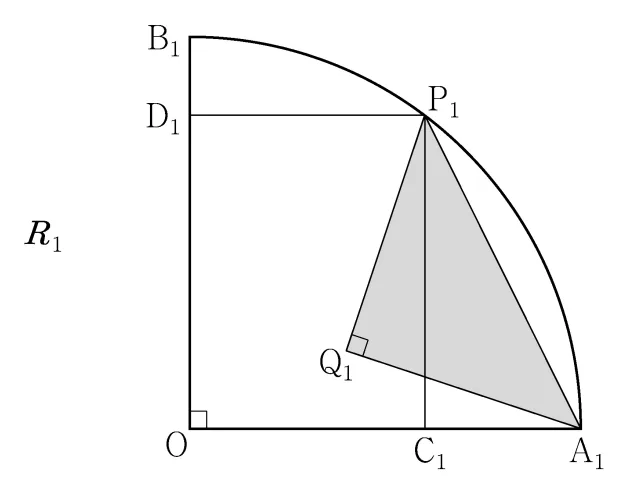
27. 그림과 같이 중심이 O, 반지름의 길이가 $1$이고 중심각의 크기가 $\dfrac\pi2$인 부채꼴 $\mathrm{O}\mathrm{A}_{1}\mathrm{B}_{1}$이 있다. 호 $\mathrm{A}_{1}\mathrm{B}_{1}$ 위에 점 $\mathrm{P}_{1}$, 선분 $\mathrm{O}\mathrm{A}_{1}$ 위에 점 $\mathrm{C}_{1}$, 선분 $\mathrm{O}\mathrm{B}_{1}$ 위에 점 $\mathrm{D}_{1}$을 사각형 $\mathrm{O}\mathrm{C}_{1}\mathrm{P}_{1}\mathrm{D}_{1}$이 $\overline{\mathrm{OC}_1}:\overline{\mathrm{OD}_1}=3:4$인 직사각형이 되도록 잡는다.
부채꼴 $\mathrm{O}\mathrm{A}_{1}\mathrm{B}_{1}$의 내부에 점 $\mathrm{Q}_{1}$을 $\overline{\mathrm P_1\mathrm Q_1}=\overline{\mathrm A_1\mathrm Q_1}$, $\angle\mathrm P_1\mathrm Q_1\mathrm A_1=\dfrac\pi2$가 되도록 잡고, 이등변삼각형 $\mathrm{P}_{1}\mathrm{Q}_{1}\mathrm{A}_{1}$에 색칠하여 얻은 그림을 $R_1$이라 하자.
그림 $R_1$에서 선분 $\mathrm{O}\mathrm{A}_{1}$ 위의 점 $\mathrm{A}_{2}$와 선분 $\mathrm{O}\mathrm{B}_{1}$ 위의 점 $\mathrm{B}_{2}$를 $\overline{\mathrm{OQ}_1}=\overline{\mathrm{OA}_2}=\overline{\mathrm{OB}_2}$가 되도록 잡고, 중심이 O, 반지름의 길이가 $\overline{\mathrm{OQ}_1}$, 중심각의 크기가 $\dfrac\pi2$인 부채꼴 $\mathrm{O}\mathrm{A}_{2}\mathrm{B}_{2}$를 그린다. 그림 $R_1$을 얻은 것과 같은 방법으로 네 점 $\mathrm{P}_{2}$, $\mathrm{C}_{2}$, $\mathrm{D}_{2}$, $\mathrm{Q}_{2}$를 잡고, 이등변삼각형 $\mathrm{P}_{2}\mathrm{Q}_{2}\mathrm{A}_{2}$에 색칠하여 얻은 그림을 $R_2$라 하자.
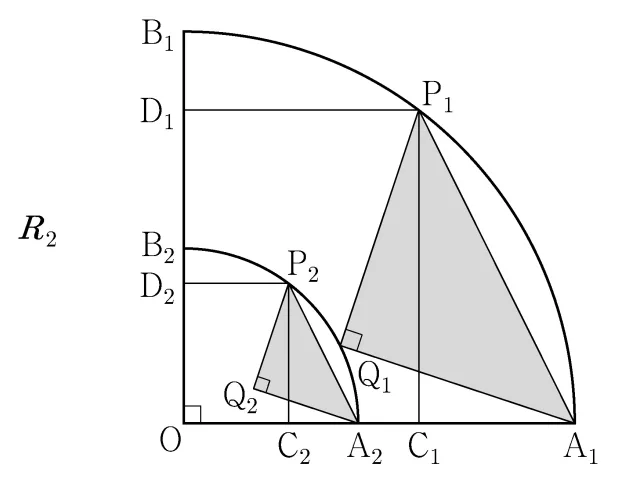
이와 같은 과정을 계속하여 $n$번째 얻은 그림 $R_n$에 색칠되어 있는 부분의 넓이를 $S_n$이라 할 때, $\displaystyle\lim\limits_{n\to\infty}S_n$의 값은? [3점]
① $\dfrac9{40}$ ② $\dfrac14$ ③ $\dfrac{11}{40}$ ④ $\dfrac3{10}$ ⑤ $\dfrac{13}{40}$
풀이
$\overline{\mathrm{OC}_1}=3t$, $\overline{\mathrm{OD}_1}=4t$로 놓으면 직사각형의 대각선 $\overline{\mathrm{OP}_1}=5t=1$이므로 $t=\dfrac15$이다.
$\overline{\mathrm{A}_1\mathrm{C}_1}=1-\dfrac35=\dfrac25$, $\overline{\mathrm{C}_1\mathrm{P}_1}=\dfrac45$이므로 $\overline{\mathrm{A}_1\mathrm{P}_1}=\sqrt{(2/5)^2+(4/5)^2}=\dfrac2{\sqrt5}$이다.
삼각형 $\mathrm{P}_{1}\mathrm{Q}_{1}\mathrm{A}_{1}$은 직각이등변삼각형이므로 $\overline{\mathrm{A}_1\mathrm{Q}_1}=\overline{\mathrm{P}_1\mathrm{Q}_1}=\dfrac{\sqrt2}{\sqrt5}$이고 $S_1=\dfrac12\left(\dfrac{\sqrt2}{\sqrt5}\right)^2=\dfrac15$이다.
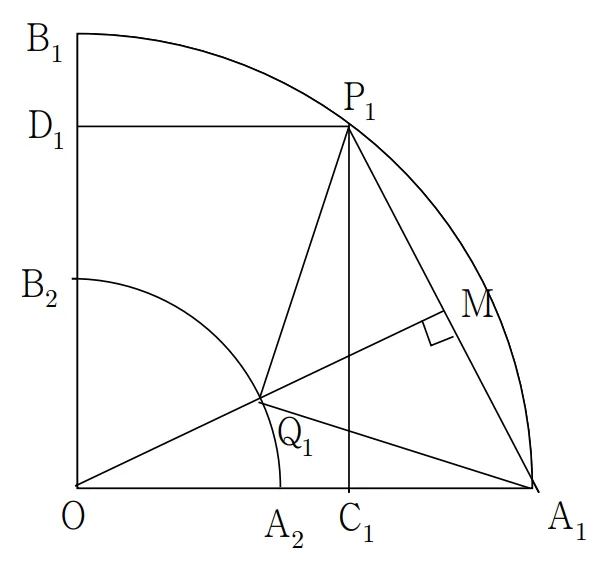
선분 $\mathrm{A}_{1}\mathrm{P}_{1}$의 중점을 M이라 하면 $\overline{\mathrm{OM}}=\sqrt{1^2-(1/\sqrt5)^2}=\dfrac2{\sqrt5}$이다. 세 점 O, $\mathrm{Q}_{1}$, M이 한 직선 위에 있으므로 $\overline{\mathrm{OQ}_1}=\dfrac2{\sqrt5}-\dfrac1{\sqrt5}=\dfrac1{\sqrt5}$이다.
따라서 연속하는 부채꼴의 반지름의 비는 $1:\dfrac1{\sqrt5}$이고, 색칠한 삼각형의 넓이의 비는 $1:\dfrac15$이다.
$\begin{aligned}\displaystyle\lim\limits_{n\to\infty}S_n&=\dfrac15\left(1+\dfrac15+\dfrac1{5^2}+\cdots\right)\\&=\dfrac{\frac15}{1-\frac15}=\dfrac14\end{aligned}$
정답: ② $\dfrac14$
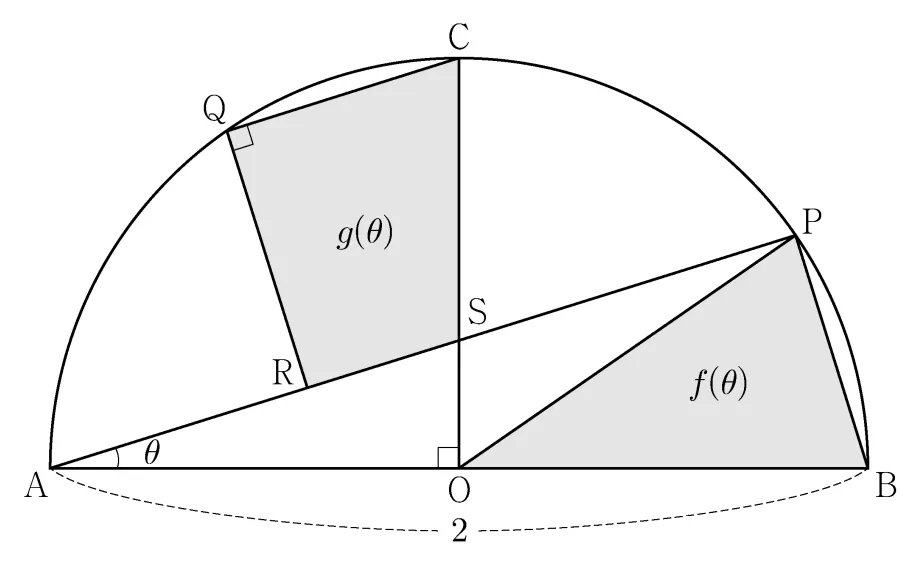
28. 그림과 같이 중심이 O이고 길이가 $2$인 선분 AB를 지름으로 하는 반원 위에 $\angle\mathrm{AOC}=\dfrac\pi2$인 점 C가 있다.
호 BC 위에 점 P와 호 CA 위에 점 Q를 $\overparen{\mathrm{PB}}=\overparen{\mathrm{QC}}$가 되도록 잡고, 선분 AP 위에 점 R를 $\angle\mathrm{CQR}=\dfrac\pi2$가 되도록 잡는다. 선분 AP와 선분 CO의 교점을 S라 하자. $\angle\mathrm{PAB}=\theta$일 때, 삼각형 POB의 넓이를 $f(\theta)$, 사각형 CQRS의 넓이를 $g(\theta)$라 하자. $\displaystyle\lim\limits_{\theta\to0+}\dfrac{3f(\theta)-2g(\theta)}{\theta^2}$의 값은? (단, $0<\theta<\dfrac\pi4$) [4점]
① $1$ ② $2$ ③ $3$ ④ $4$ ⑤ $5$
풀이
반지름이 $1$인 반원에서 $\angle\mathrm{OAP}=\angle\mathrm{OPA}=\theta$이므로 중심각 $\angle\mathrm{BOP}=2\theta$이다. 따라서 $f(\theta)=\dfrac12\sin2\theta=\sin\theta\cos\theta$이다.
$\overline{\mathrm{OA}}=1$, $\angle\mathrm{OAS}=\theta$에서 $\overline{\mathrm{OS}}=\tan\theta$, $\overline{\mathrm{CS}}=1-\tan\theta$이다.
호 PB와 호 QC가 같으므로 $\overline{\mathrm{CQ}}=\overline{\mathrm{BP}}=2\sin\theta$이고, $\angle\mathrm{SCQ}=\dfrac\pi2-\theta$이다.
점 S에서 변 CQ에 내린 수선의 발을 H라 하면 $\overline{\mathrm{SH}}=\overline{\mathrm{QR}}=(1-\tan\theta)\cos\theta$, $\overline{\mathrm{CH}}=(1-\tan\theta)\sin\theta$이다.
따라서 $\overline{\mathrm{RS}}=\overline{\mathrm{QH}}=2\sin\theta-(1-\tan\theta)\sin\theta=\sin\theta(1+\tan\theta)$이다.
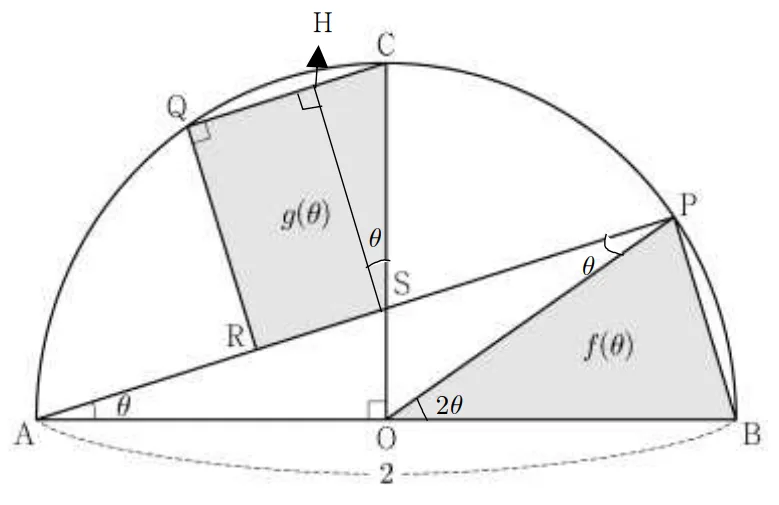
사각형 CQRS는 평행한 변 CQ와 RS를 밑변으로 하는 사다리꼴이므로 $g(\theta)=\dfrac12\left(2\sin\theta+\sin\theta(1+\tan\theta)\right)(1-\tan\theta)\cos\theta$이다.
$\begin{aligned}3f(\theta)-2g(\theta)&=3\sin\theta\cos\theta-\sin\theta\cos\theta(3+\tan\theta)(1-\tan\theta)\\&=\sin\theta\cos\theta\tan\theta(2+\tan\theta)\end{aligned}$
$\begin{aligned}\displaystyle\lim\limits_{\theta\to0+}\dfrac{3f(\theta)-2g(\theta)}{\theta^2}&=\displaystyle\lim\limits_{\theta\to0+}\dfrac{\sin\theta}{\theta}\dfrac{\tan\theta}{\theta}\cos\theta(2+\tan\theta)\\&=1\times1\times1\times2=2\end{aligned}$
정답: ② $2$
미적분 단답형
29. 세 상수 $a$, $b$, $c$에 대하여 함수 $f(x)=ae^{2x}+be^x+c$가 다음 조건을 만족시킨다.
(가) $\displaystyle\lim\limits_{x\to-\infty}\dfrac{f(x)+6}{e^x}=1$
(나) $f(\ln2)=0$
함수 $f(x)$의 역함수를 $g(x)$라 할 때, $\displaystyle\int\nolimits_0^{14}g(x)\,dx=p+q\ln2$이다. $p+q$의 값을 구하시오. (단, $p$, $q$는 유리수이고, $\ln2$는 무리수이다.) [4점]
풀이
조건 (가)의 분자를 나누면 $\dfrac{f(x)+6}{e^x}=ae^x+b+(c+6)e^{-x}$이다.
$x\to-\infty$일 때 극한이 $1$이려면 $c+6=0$, $b=1$이어야 하므로 $c=-6$, $b=1$이다.
조건 (나)에서 $f(\ln2)=4a+2-6=0$이므로 $a=1$이고 $f(x)=e^{2x}+e^x-6$이다.
$f'(x)=2e^{2x}+e^x>0$이므로 $f$는 일대일대응인 증가함수이고 $g$가 역함수이다.
$f(\ln2)=0$이고 $f(\ln4)=16+4-6=14$이므로 $g(0)=\ln2$, $g(14)=\ln4$이다.
역함수 적분 공식 또는 치환 $x=f(t)$를 적용하면 $\displaystyle\int\nolimits_0^{14}g(x)\,dx=\displaystyle\int\nolimits_{\ln2}^{\ln4}t f'(t)\,dt$이다.
$\begin{aligned}\displaystyle\int\nolimits_0^{14}g(x)\,dx&=\left[t f(t)\right]_{\ln2}^{\ln4}-\displaystyle\int\nolimits_{\ln2}^{\ln4}f(t)\,dt\\&=14\ln4-\left[\dfrac{e^{2t}}2+e^t-6t\right]_{\ln2}^{\ln4}\\&=28\ln2-(8-6\ln2)\\&=34\ln2-8\end{aligned}$
$p=-8$, $q=34$이므로 $p+q=26$이다.
정답: $26$
30. 최고차항의 계수가 양수인 삼차함수 $f(x)$와 함수 $g(x)=e^{\sin\pi x}-1$에 대하여 실수 전체의 집합에서 정의된 합성함수 $h(x)=g(f(x))$가 다음 조건을 만족시킨다.
(가) 함수 $h(x)$는 $x=0$에서 극댓값 $0$을 갖는다.
(나) 열린구간 $(0,3)$에서 방정식 $h(x)=1$의 서로 다른 실근의 개수는 $7$이다.
$f(3)=\dfrac12$, $f'(3)=0$일 때, $f(2)=\dfrac qp$이다. $p+q$의 값을 구하시오. (단, $p$와 $q$는 서로소인 자연수이다.) [4점]
풀이
$f(x)=ax^3+bx^2+cx+d$ ($a>0$)로 놓으면 $f'(x)=3ax^2+2bx+c$이다.
$h(0)=e^{\sin\pi d}-1=0$에서 $\sin\pi d=0$이므로 $d$는 정수이다.
$h'(x)=\pi e^{\sin\pi f(x)}\cos(\pi f(x))f'(x)$이고, $h'(0)=\pi\cos(\pi d)c=0$이다. 정수 $d$에 대하여 $\cos\pi d\ne0$이므로 $c=0$이다.
$f(3)=\dfrac12$, $f'(3)=0$에서 $27a+9b+d=\dfrac12$, $27a+6b=0$, 즉 $9a+2b=0$이다.
$b=-\dfrac{9a}2<0$이고 $f'(x)=3ax(x-3)$이므로 $x=0$에서 극대, $x=3$에서 극소이다.
$f(3)=\dfrac12$에서 $d-\dfrac{27a}2=\dfrac12$이므로 $d=\dfrac12+\dfrac{27a}2>0$이다. 따라서 $d$는 자연수이다.
$h$도 $x=0$에서 극대가 되려면 그 근방에서 $g'(f(x))=\pi e^{\sin\pi f(x)}\cos\pi f(x)>0$이어야 한다. 따라서 $\cos\pi d>0$이고 정수 $d$는 짝수이다.
$0<x<3$에서 $f'(x)<0$이므로 $f$는 $d=f(0)$에서 $\dfrac12=f(3)$까지 엄격히 감소한다. 이때 $h(x)=1$은 $\sin(\pi f(x))=\ln2$와 동치이다.
$0<\ln2<1$이다. $t\in(\frac12,d)$에서 $\sin\pi t=\ln2$의 서로 다른 해가 정확히 $7$개이고 $d$가 양의 짝수이려면 $d=8$이다. $d=2,4,6$에서는 각각 $1,3,5$개이고 $d=8$에서는 $7$개이다.
$d=8$이므로 $\dfrac12+\dfrac{27a}2=8$에서 $a=\dfrac59$, $b=-\dfrac52$이다.
$f(x)=\dfrac59x^3-\dfrac52x^2+8$이므로 $f(2)=\dfrac{40}9-10+8=\dfrac{22}9$이다. 따라서 $p=9$, $q=22$이다.
정답: $31$